School of Arts & Sciences Newsletter: December 2023

School of Arts & Sciences Newsletter: December 2023

Message From the Dean

It's the end of the fall semester, but our hard-working students and faculty show no signs of letting up as new recognition and support for their research and scholarship is reported each week. In this month's newsletter, you'll read about some very significant funding for research, including communication between cells in the body, testing of a new Alzheimer’s treatment, sustainable food packaging, and treatment of agricultural pollution. You'll also see articles on the recognition of our students. Please enjoy this issue of the School of Arts & Sciences Newsletter!

— Darryl Scriven, Dean of Arts & Sciences, Fellow in The Shipley Center for Innovation

Cell-to-Cell Communication

Image
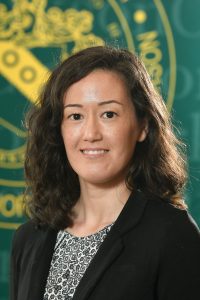
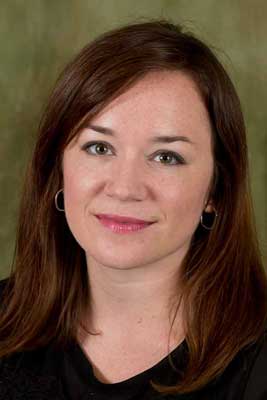
Headshot, Ginger Hunter

The National Institutes of Health awarded Assistant Professor of Biology Ginger Hunter a nearly $1.8 million Maximizing Investigators’ Research Award for Early Stage Investigators. Her work is studying how human body cell structures called cytonemes are regulated and how they contribute to the ability of cells to coordinate their activities during patterning. Defects in cell-cell communication during patterning can lead to human disorders and disease.
Read More About This Research Award
 

Removing Phosphate Pollution

Image
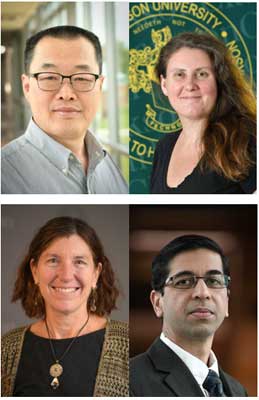
side-by-side portraits of Silvana Andreescu and Stefan Grimberg

Two professors and their research partners were awarded a $749,000 grant from the Department of Agriculture to develop a filtration system to capture and recover phosphate from agricultural drainage. The recovered phosphate could be used as a fertilizer and to provide a renewable supply and economic opportunities to farmers.
Read More About This Grant
 

Testing Alzheimer’s Treatment

Image
chest-up portrait of Ka Ho Leung in a blue suit jacket and open-collared light blue shirt

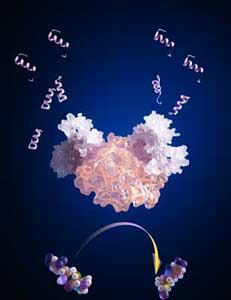
Assistant Professor of Chemistry Ka Ho Leung was awarded a nearly $300,000 grant from the National Institutes of Health to test a new treatment that targets specific channels in cells to see if it can help reduce the harmful sustained immune response in Alzheimer's disease. The increasing prevalence of Alzheimer’s disease and the lack of successful drugs in clinical trials have caused a significant healthcare burden. 
Read More About This Grant 
 

Sustainable Food Packaging

Image
Silvana Andreescu (left) stands with two students presenting a poster on Food Spoilage Mitigation through packaging.

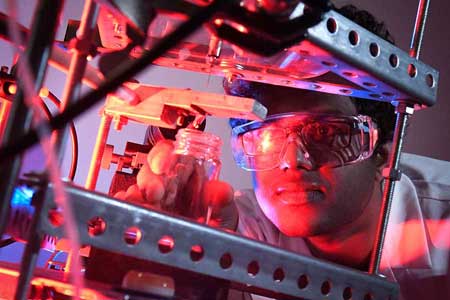
Egon Matijević Endowed Chair of Chemistry & Biomolecular Science Silvana Andreescu and her student team received a New York State Pollution Prevention Institute grant for their research into a new type of 3D printed packaging fabricated from green and sustainable sources. It monitors and maintains food quality and increases its shelf life, reducing food waste.
Read More About This Research
 

Lewis School of Health & Life Sciences Newsletter: November 2023

Lewis School of Health & Life Sciences Newsletter: November 2023

Message From the Founding Dean

Welcome to the November edition of our Earl R. and Barbara D. Lewis School of Health & LifeSciences Newsletter. The first hint of cold weather has arrived at our downtown Potsdam campus, but students in all of our programs are busy warming up to their studies and sharing their knowledge in our community. In this newsletter, you'll find out how occupational therapy students are helping local seniors to be better drivers, how we're teaching high schoolers and their teachers about neuroscience and how Caribbean grad students are learning about climate change and health. I hope you enjoy reading about our students and faculty as we advance careers in health science through innovation and research.

— Lennart Johns, Founding Dean of Health Sciences

NIH BRAIN-STEM

Image
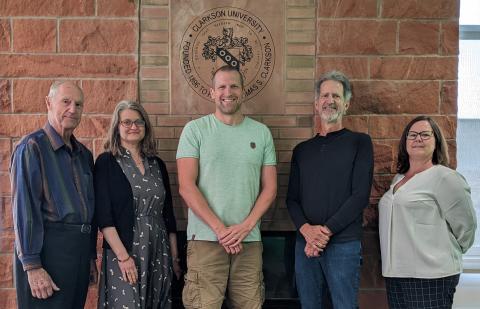
Portrait of Robert Dowman, Katie Kavanagh and Lennart Johns outside Snell Hall on the Clarkson University Collins Hill Campus

The  Lewis School of Health & Life Sciences and the Institute for STEM Education were awarded a $1.25 million NIH grant to increase rural students' interest in pursuing a healthcare career. Building Rural Aspirations In Neuroscience with Science, Technology, Engineering and Mathematics – or BRAIN-STEM – will offer high school students and teachers five-day summer camps and an afterschool program to explore neuroscience.


Read More About This Grant
 

Climate Bioethics

Image
Logo, reading "Clarkson (TM). The Bioethics Program. With Clarkson University seal on left."

A new climate bioethics program will recruit Caribbean Research Ethics Education Initiative program graduate students to spend a year learning about climate change and health and exploring ethics questions often overlooked in research, policy and practice. The program aims to enhance health equity in the Caribbean, a region uniquely vulnerable to climate change due to its geography and socioeconomics.

Read More About This Program
 

CarFit for Seniors (Video)

Image
Two Clarkson University occupational therapy students in fluorescent green vests approach a woman in a small white SUV wagon.

The Occupational Therapy Department recently offered senior drivers an opportunity to check how their cars “fit” them. OT students became certified CarFit technicians while recommending minor adjustments that help make cars “fit” better for comfort and safety. An occupational therapist provided information on how to maintain and strengthen driving health. 

Watch The Video
 

Best Value

Image
Exterior of Bertrand H. Snell Hall on Clarkson University's hill campus with flowers and a tree in the foreground and a partly cloudy blue sky.

The 2024 edition of U.S. News & World Report Best Colleges has ranked Clarkson in the top 50 Best Value Schools in the nation. U.S. News also continues to rank Clarkson in tier one, the top tier of national universities. Strong performances in teaching, research and scholarship led to Clarkson again being ranked highly. 

Read More About This Ranking